AstroXMat Research Laboratory Explores Partnership with Kwame Nkrumah Memorial Park to Promote Astrotourism in Ghana
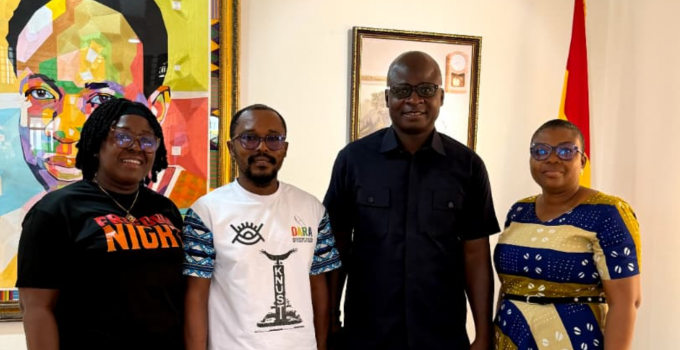
The AstroXMat Research Laboratory of the Department of Physics, Kwame Nkrumah University of Science and Technology (KNUST), is exploring a potential partnership with the Kwame Nkrumah Memorial Park and Mausoleum to promote astrotourism and public engagement with astronomy and space science in Ghana.
The proposed collaboration follows a preliminary meeting between Dr. Linus Kweku Labik, Principal Investigator of the AstroXMat Research Laboratory, and Dr. Collins Nunyonameh, Managing Director of the Kwame Nkrumah Memorial Park and Mausoleum. The meeting focused on identifying areas of mutual interest and exploring opportunities for collaboration between the two institutions.
The proposed partnership seeks to bring together Ghana’s rich historical and cultural heritage with astronomy and space science by creating educational and tourism experiences that allow visitors to explore the night sky while gaining a deeper appreciation of science.
If developed, the initiative could introduce astronomy-focused activities at the Memorial Park, creating new opportunities for public education, scientific engagement and tourism. It could also contribute to the development of astrotourism as an emerging area of tourism in Ghana.
Astrotourism involves travelling to destinations to observe and experience astronomical phenomena, including stars, planets, meteor showers and other features of the night sky. Globally, heritage sites, parks and other culturally significant locations are increasingly being used as platforms for astronomy education and public engagement.
For the AstroXMat Research Laboratory, the proposed collaboration presents an opportunity to take astronomy beyond conventional academic and research environments and make the subject more accessible and engaging to the wider public.
The Kwame Nkrumah Memorial Park, which commemorates Ghana’s first President, Dr. Kwame Nkrumah, offers a significant historical and cultural setting for such an initiative. Its integration with astronomy and space science could create a unique platform where history, science, education and tourism converge.
The discussions between the two parties are currently at a preliminary stage, with both sides exploring areas of mutual interest and possible activities that could form part of a future collaboration.
A successful partnership could provide visitors with a new way of experiencing Ghana’s historical heritage while promoting interest in astronomy and space science. It could also contribute to positioning Ghana as an emerging destination for astronomy-based tourism and science outreach.
The initiative reflects the growing potential for collaboration between academic research institutions and cultural and tourism establishments in creating innovative platforms for science communication, education and public engagement