Eugene Adomako Mensah Profile
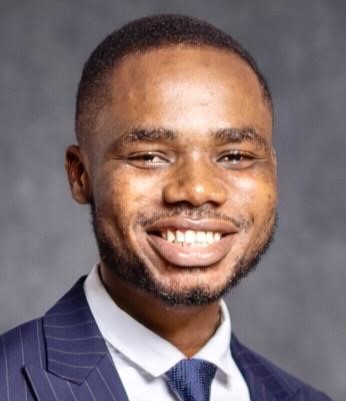 Eugene Adomako Mensah is a master’s student in the REALMATHS Double Degree Programme between the Kwame Nkrumah University of Science and Technology (KNUST), Ghana, and the University of L’Aquila, Italy. He is pursuing an MPhil in Mathematical and Computational Physics, specialising in Quantum Science and Technology, at KNUST, alongside an MSc in Mathematical Engineering at the University of L’Aquila. He has a bachelor's degree in Physics and Applied Mathematics)
His master’s thesis focuses on Physics-Informed Graph Neural Network Surrogates for Quantum Optimal Control Fidelity Landscapes. His research investigates the use of physics-informed machine learning and graph neural networks to develop efficient surrogate models for quantum optimal control, with an emphasis on predicting quantum control fidelities while accounting for the physical structure and constraints of quantum systems.
His broader research interests include quantum computing, quantum sensing, quantum systems and control, computational physics, and condensed-matter physics. He is particularly interested in combining machine learning, quantum simulation, and mathematical modelling to address computational challenges in quantum technologies.
Alongside his main research, he is exploring the application of quantum sensing to environmental monitoring through a side project on exploiting nitrogen-vacancy (NV) centre defects in diamond for the detection of mercury ions (Hg²⁺) in water.
Eugene has experience in computational modelling and scientific programming, with previous projects involving quantum simulation of spin chains in optical systems, molecular dynamics simulations of copper and gold nanoparticle sintering using LAMMPS, and acoustic modelling of lecture halls using COMSOL Multiphysics. He previously served as a Teaching Assistant in the Department of Physics at KNUST, supporting instruction in computational physics, circuit theory, experimental physics, and solid mechanics.
He has participated in several advanced training programmes in quantum science and theoretical physics, including the Perimeter Scholars International Start and Bridge programmes, the E-learning African International School on Quantum Science and Technology, and a postgraduate course in quantum information science and engineering at KNUST. He also contributes to quantum science outreach through GQuantum Education, helping introduce high-school students to quantum science and technology.
HONORS AND AWARD
- Visiting master’s student – University of L’Aquila, Italy
- International mobility Scholarship Award – Azienda per il Diritto agli Studi Universitari dell’Aquila (ADSU), 2025/2026
- TNE International Mobility Programme: October 2025-February 2026
- Erasmus+ International Mobility Programme: March 2026-July 2026
SELECTED ACADEMIC TRAINING
1. Perimeter Scholars International Bridge Program, Perimeter Institute (2025)
Undertook advanced training in statistical physics, quantum mechanics, classical mechanics, and Lie algebra for particle physics.
1. Perimeter Scholars International Start Program, Perimeter Institute (2025)
Studied supersymmetric quantum mechanics, tensor networks, group theory and Dirac equations, and cosmic structure formation.
1. Quantum Class for Postgraduate Students, KNUST (2025)
Participated in an intensive course on quantum information science and engineering delivered by Professor Wayne Scales of Virginia Tech.
1. E-learning African International School on Quantum Science and Technology, KNUST (2024–2025)
Completed a six-month training programme covering quantum computing, quantum algorithms, and quantum machine learning.
CURRENT RESEARCH PROJECT
Physics-Informed Graph Neural Network Surrogates for Quantum Optimal Control Fidelity Landscapes
This master’s thesis investigates the development of physics-informed graph neural network surrogate models for quantum optimal control. The objective is to explore how graph-based representations and physical constraints can support efficient prediction of quantum control fidelities, potentially reducing the computational cost associated with repeated quantum-dynamics simulations during control optimisation.
ADDITIONAL RESEARCH PROJECT
Exploiting Nitrogen-Vacancy Centre Defects in Diamond for Mercury-Ion Detection in Water
This side project investigates the potential application of nitrogen-vacancy centres in diamond for quantum sensing, with a focus on detecting mercury ions in water for environmental monitoring.
TECHNICAL SKILLS
* Programming: Python, C++.
* Quantum Computing and Simulation: Qutip,Cirq, PennyLane.
* Computational Modelling: COMSOL Multiphysics, LAMMPS, Atomic Simulation Environment (ASE), OVITO, VESTA.