Stronger academia–industry collaboration needed in quantum sector – Prof. Heather Lewandowski says ahead of AoCQ

A pre-conference meeting bringing together key stakeholders in academia, industry and policy has been held ahead of the African International Conference on Quantum Computing and Simulation (AoCQ), scheduled for February 2026 at the Kwame Nkrumah University of Science and Technology (KNUST).
The engagement formed part of efforts to align national and continental priorities on quantum science and technology, with a focus on developing a coordinated quantum strategy for Ghana and beyond.
Moderating the session, Mrs Dorcas Addo said the goal of the workshop was to achieve strategic clarity and alignment among diverse stakeholders.
“The aim is to bring diverse perspectives into strategic alignment so that academic research, industrial needs and societal development objectives reinforce one another constructively, rather than operating as isolated or competing efforts,” she said.
A key presentation was delivered by Prof. Heather J. Lewandowski of the Department of Physics at the University of Colorado, who spoke on academic–industry collaboration as a driver of social and workforce development.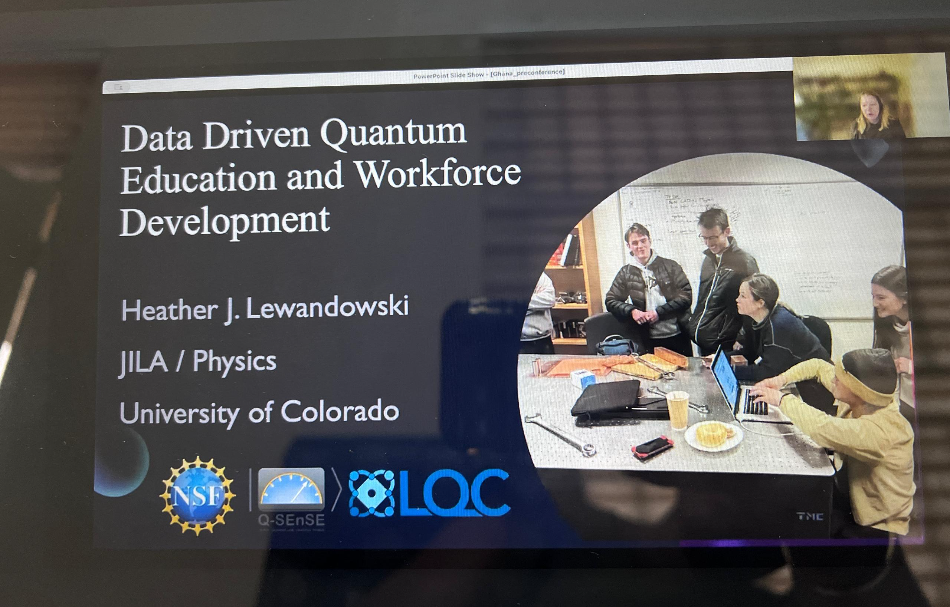
Prof. Lewandowski highlighted the need for stronger partnerships between universities and industry to build a skilled and resilient quantum workforce, noting that emerging trends in quantum science require new forms of preparation for students.
Drawing on findings from data-driven research on quantum education and workforce development, she stressed the importance of industry-generated data in shaping curricula that better prepare students for careers in quantum science and broader STEM fields.
She also discussed the evolving job landscape within the quantum industry, pointing to the need for broader job categorisation and clearer pathways to employment. On challenges to collaboration, she proposed the adoption of structured frameworks to guide partnerships, while ensuring industry commitment to student training and mentorship.
Addressing gender representation, Prof. Lewandowski noted that women remain significantly underrepresented in quantum physics, largely due to longstanding diversity gaps in physics and engineering.
“We need stronger mentorship structures to help people better understand their career paths. There is a lot more work to be done to improve inclusion,” she said.
She further shared insights from quantum education and workforce studies on the future of quantum-related jobs and skills, emphasising that the growing industry offers diverse opportunities beyond highly specialised roles.
Prof. Lewandowski encouraged students and postdoctoral researchers to take advantage of emerging opportunities, noting that not all roles in the quantum sector require advanced degrees in quantum physics.
Among her recommendations were the need for hands-on experience through internships, research placements and laboratory courses; developing basic quantum literacy by taking a few courses in quantum information science and technology (QIST); maintaining strong foundational STEM skills; and avoiding undue pressure to become narrowly defined “quantum engineers”.
The workshop is expected to contribute to ongoing discussions toward a coordinated national quantum strategy, ahead of the continental conference at KNUST in 2026.